Generative AI: Understanding the Core Concept
Slide 1 provides a foundational introduction to Generative AI what it is, how it works, and why it is transformative across industries.
Start Exploring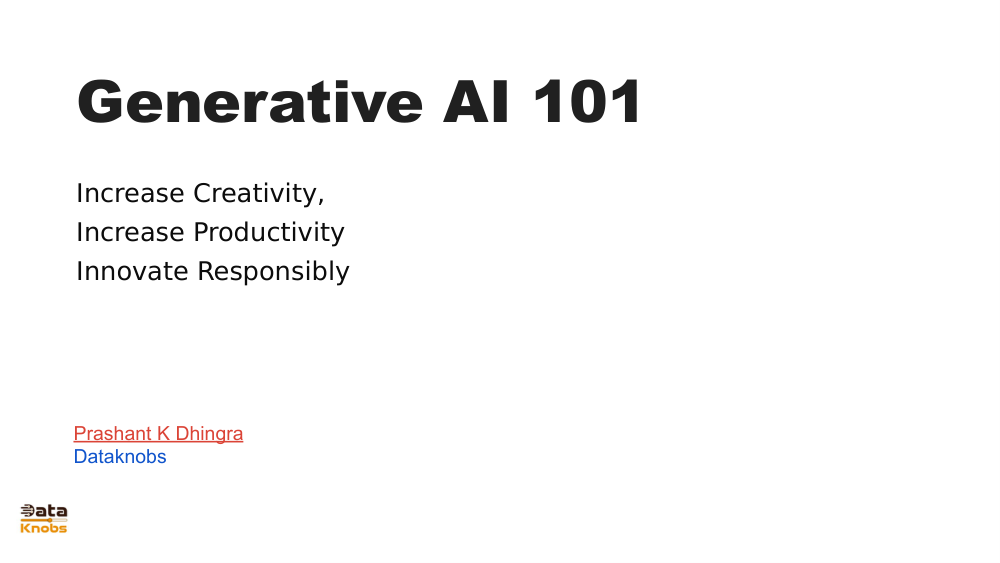
Slide 1 provides a foundational introduction to Generative AI what it is, how it works, and why it is transformative across industries.
Start Exploring
Generative AI refers to models capable of creating new content such as text, images, audio, code, and more. Instead of simply recognizing patterns, these models generate entirely new outputs based on learned data distributions.
Learns patterns from data and generates similar but original output.
Uses neural networks trained on massive amounts of text, images, or audio.
Produces high-quality content that appears human-made.
The computational structures that allow machines to learn patterns and relationships.
Large datasets such as text corpora or image libraries used to teach AI models.
Output is produced by predicting the most likely next element in a sequence.
Generative AI = Data + Neural Networks + Training + Probabilistic Output Result: New, high-quality content created autonomously.
Millions of text documents or images.
Neural networks learn patterns and meanings.
AI encodes knowledge in vector space.
AI produces text, images, or other content.
Chatbots, article writing, summarization.
Art creation, design mockups, photorealistic images.
Assisted coding, automation scripts, debugging suggestions.
Generative AI is a subset of machine learning focused on content creation.
It assists creativity but does not fully replace human intuition or emotion.
Yes, generative models rely on large datasets to learn patterns.
Continue to the next slide to dive deeper into models, architectures, and capabilities.
Next Slide