Generative AI – Concept Explained
Understanding Slide 3: How Generative AI learns patterns and produces new content.
Understanding Slide 3: How Generative AI learns patterns and produces new content.
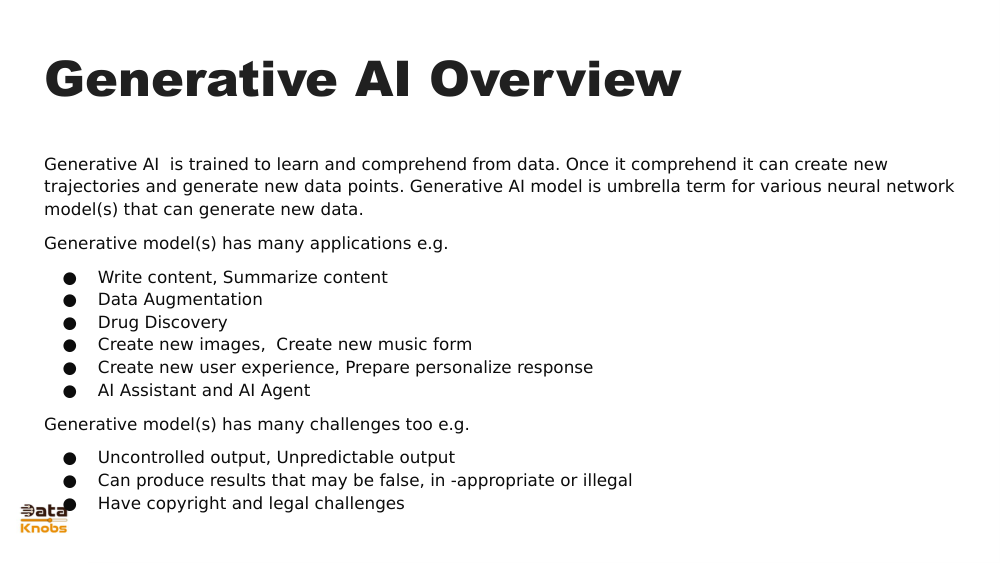
Slide 3 illustrates how generative AI models capture statistical patterns from data and use them to generate new, coherent outputs. These models don’t simply store information they learn underlying structures and relationships.
Models learn how language, images, or sounds naturally occur and behave in large datasets.
Outputs are created by predicting the next most likely element: word, pixel, or token.
Data is mapped into vectors so the model can understand relationships at a mathematical level.
Large datasets of text, images, or audio.
Model identifies patterns using neural networks.
Knowledge stored as mathematical representations.
Model predicts new text, images, or audio based on learned patterns.
No. Generative AI is a subset that focuses on creating new data rather than making classifications.
It learns patterns, not exact copies, though outputs may resemble training styles.
It visualizes how models transform raw examples into a learned pattern space that enables generation.
Explore deeper topics like embeddings, transformers, and training mechanics.
Learn More