Data Cloud Platforms: Feature Matrix
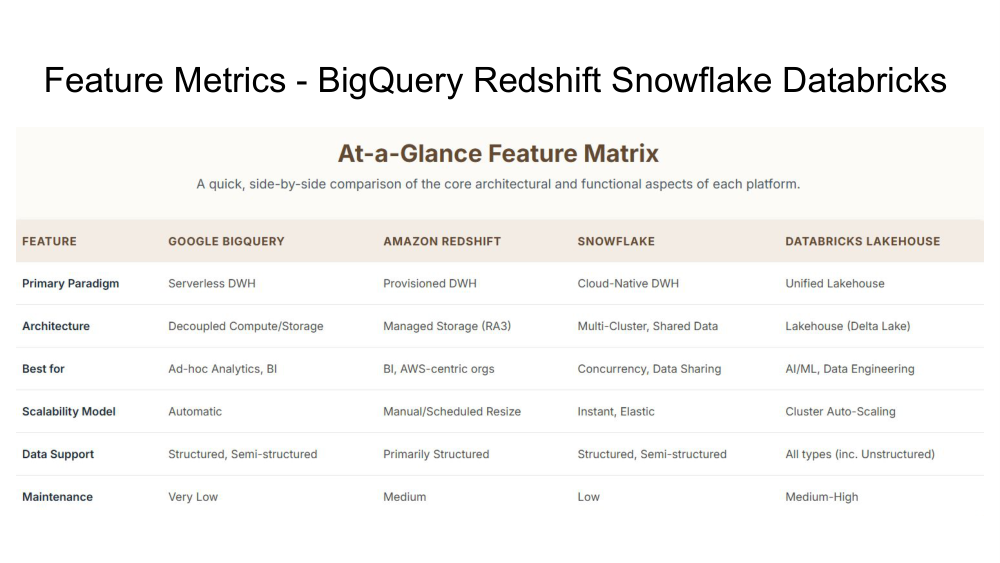
To navigate the modern data cloud landscape effectively, one must consider the four major platforms, each with unique architectures, strengths, and use cases. Selecting the best platform for your organization involves assessing your specific requirements, current infrastructure, and future goals. This thorough guide offers the analysis necessary to make a well-informed choice.
At-a-Glance Feature Matrix
Key Decision Factors
Cloud Provider: Existing infrastructure and ecosystem preferences matter. Workload Type: Analytics, ML, or data engineering focus. Scale & Concurrency: Number of concurrent users and query complexity. Cost Model: Predictable vs. variable costs. Data Types: Structured only vs. multi-modal data. Maintenance Tolerance: Fully-managed vs. hands-on preference.
Google BigQuery: Serverless Data Warehouse
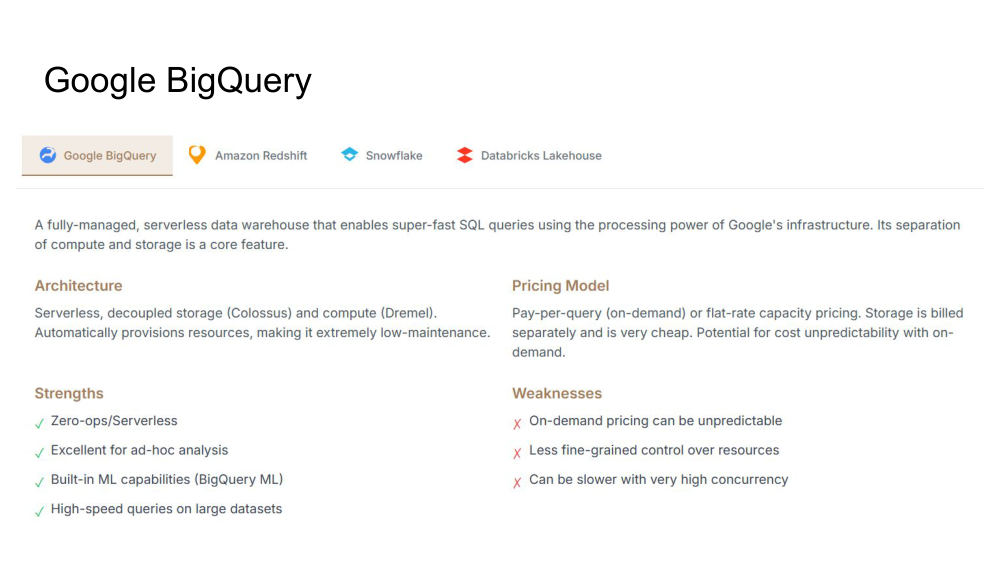
BigQuery is a serverless data warehouse managed by Google that allows for lightning-fast SQL queries thanks to its extensive infrastructure. Its unique architecture, which separates compute and storage, offers both flexibility and cost savings.
BigQuery Overview
Architecture
Serverless storage (Colossus) and compute (Dremel) are decoupled and automatically provisioned, requiring minimal maintenance.
Pricing Model
Choose between pay-per-query (on-demand) or flat-rate capacity pricing, with storage billed separately at a low cost. There is a possibility of cost variability with on-demand pricing.
Strengths
- Zero-ops/Serverless::no cluster management needed
- Excellent for ad-hoc analysis and BI
- Built-in ML capabilities (BigQuery ML)
- High-speed queries on large datasets
Weaknesses
- On-demand pricing can be unpredictable
- Less fine-grained control over resources
- Can be slower with very high concurrency
Use Cases
Ad-hoc Analytics & Exploration
Ideal for data analysts who need to explore data without prior knowledge of the number of queries required, with no need for cluster sizing.
BI & Reporting
Ideal for business intelligence applications requiring rapid queries and consistent concurrency. Seamlessly integrates with a variety of BI tools.
Google Cloud-native Organizations
Ideal for companies that are currently leveraging Google Cloud services, seamlessly integrates with BigQuery ML, Vertex AI, and other GCP offerings.
Amazon Redshift: AWS-Integrated Data Warehouse
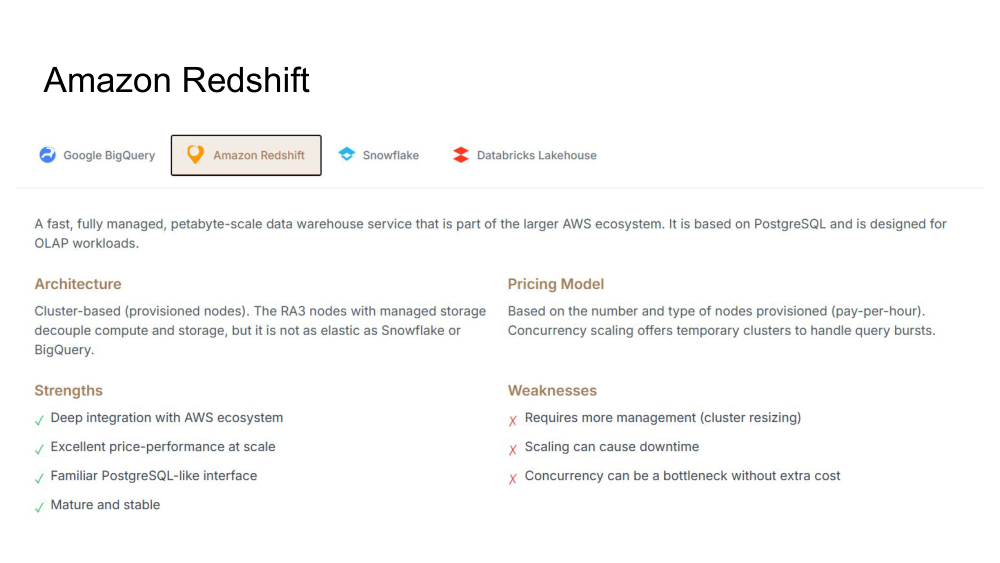
A high-speed, fully-managed data warehouse service capable of handling petabyte-scale workloads, utilizing PostgreSQL and optimized for OLAP tasks. The RA3 architecture, featuring managed storage, separates compute and storage functions, though it lacks the elasticity found in Snowflake or BigQuery.
Redshift Overview
Architecture
Cluster-based nodes with managed storage, such as RA3, separate compute and storage, however, they lack the same level of elasticity as Snowflake or BigQuery.
Pricing Model
Concurrency scaling provides temporary clusters to handle query bursts, based on the number and type of nodes provisioned and billed on a pay-per-hour basis.
Strengths
- Deep integration with AWS ecosystem
- Excellent price-performance at scale
- Mature and stable platform
Weaknesses
- Requires more management (cluster resizing)
- Scaling can cause downtime
- Concurrency can be bottleneck without extra cost
Use Cases
AWS-Centric Organizations
Extensive integration with AWS services makes this a perfect fit for organizations deeply involved in the AWS ecosystem.
Cost-Conscious at Scale
Great value for money is achieved by accurately predicting your computational requirements and adjusting your cluster size accordingly.
Mature BI & Analytics
Established platform with advanced tools and extensive operational expertise within the community.
Snowflake: Cloud-Native Data Platform
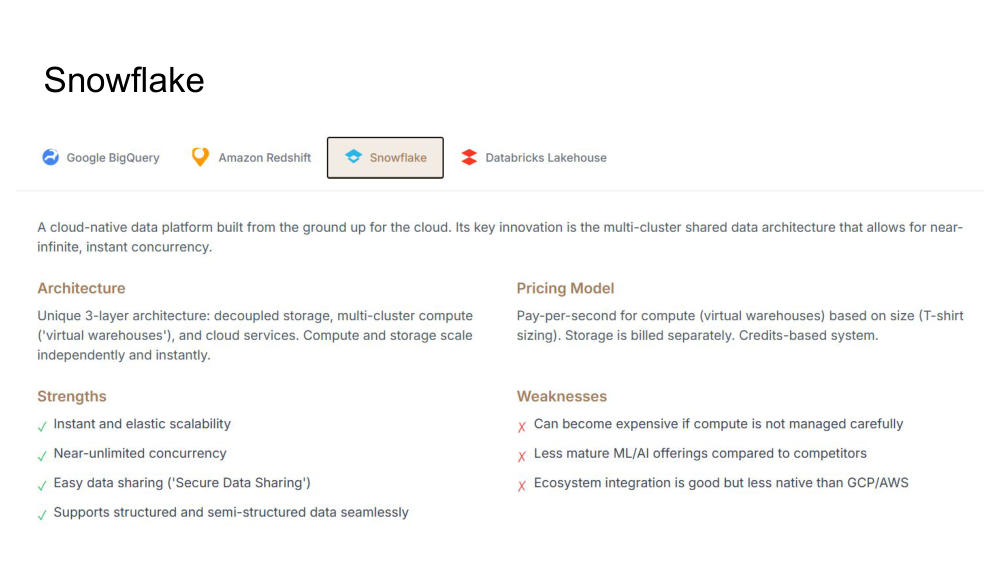
Snowflake is a cloud-native data platform specifically designed for the cloud, featuring a multi-cluster shared data architecture that enables near-infinite, instant concurrency and distinguishes it from its competitors.
Snowflake Overview
Architecture
Distinctive 3-tier structure: disconnected storage, multiple-cluster processing ('virtual warehouses'), and cloud functionalities. Scalability of compute and storage can be adjusted separately and immediately.
Pricing Model
Charged per second for compute (virtual warehouses) according to size (T-shirt sizing), with storage billed separately. Utilizes a credits-based system.
Strengths
- Instant and elastic scalability
- Near-unlimited concurrency
- Easy data sharing ('Secure Data Sharing')
- Supports structured and semi-structured data seamlessly
Weaknesses
- Can become expensive if compute not managed carefully
- Less mature ML/AI offerings compared to competitors
- Ecosystem integration is good but less native than GCP/AWS
Use Cases
High-Concurrency Environments
Snowflake's instant scaling is ideal for organizations with numerous concurrent users or fluctuating workloads.
Data Sharing & Collaboration
The secure sharing of data in Snowflake is perfect for organizations that require data sharing among teams or external partners.
Multi-Cloud Strategy
Ideal for organizations seeking cloud provider flexibility, as it is compatible with AWS, Azure, and GCP.
Databricks: Unified Lakehouse Platform
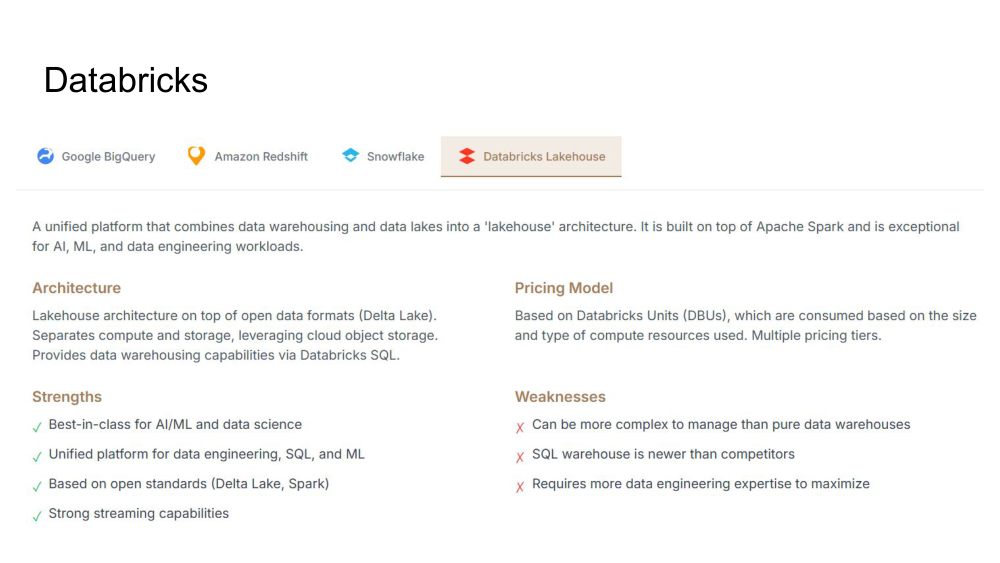
A cutting-edge platform that merges data warehousing and data lakes into a 'lakehouse' framework, leveraging Apache Spark for optimal performance in AI, ML, and data engineering tasks. While it may be challenging to operate, it offers unparalleled power for advanced applications.
Databricks Overview
Architecture
Lakehouse architecture built on Delta Lake, utilizing open data formats to separate compute and storage. Leverages cloud object storage and offers data warehousing features through Databricks SQL.
Pricing Model
Pricing tiers for various workloads are determined by the size and type of compute resources used, as measured in Databricks Units (DBUs).
Strengths
- Best-in-class for AI/ML and data science
- Unified platform for data engineering, SQL, and ML
- Based on open standards (Delta Lake, Spark)
- Strong streaming capabilities
Weaknesses
- More complex to manage than pure data warehouses
- SQL warehouse is newer than competitors
- Requires more data engineering expertise to maximize
Use Cases
AI/ML & Data Science
Advanced machine learning capabilities with integrated notebooks, MLflow, and seamless Spark integration.
Data Engineering
Perfect for companies constructing intricate data pipelines and transformations using Apache Spark.
Unified Analytics Platform
Companies seeking a single platform to handle SQL analytics, machine learning, and data engineering without the need to switch between multiple tools.
Detailed Feature Comparison
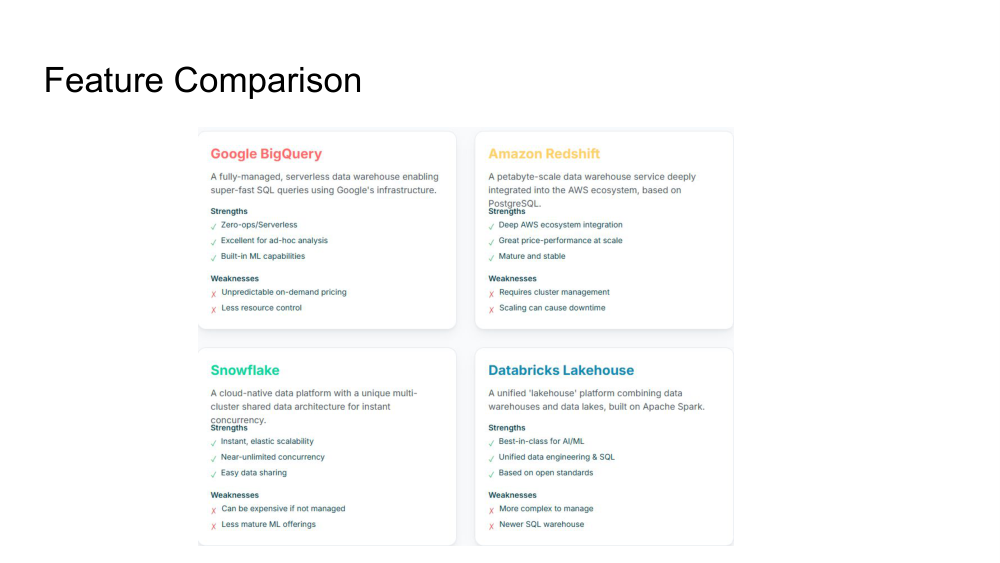
This comprehensive comparison offers a detailed analysis of each platform's features across important decision factors.
Selection Framework & Decision Guide
To select the appropriate data platform, careful consideration of your individual requirements is necessary. Utilize this guide to help guide your decision-making process.
Google Cloud: BigQuery is the natural choice. AWS: While Redshift offers deep integration, Snowflake and Databricks are also solid options. Azure: Snowflake is the top choice for multi-cloud flexibility, but Databricks is a solid alternative. Multi-cloud: Snowflake is the only pure multi-cloud option.
BI & Analytics: BigQuery or Redshift excel. AI/ML & Data Science: Databricks is unmatched. Ad-hoc Analysis: BigQuery is ideal. High-Concurrency Apps: Snowflake's instant scaling handles this best. Mixed (SQL + ML): Databricks or Snowflake.
Primarily structured: Any option works. Mix of structured/unstructured: Snowflake or Databricks. Complex multi-modal data: Databricks is your best bet. Large-scale tabular: BigQuery or Redshift excel.
Minimal ops wanted: BigQuery (truly serverless). Willing to manage: Redshift or Snowflake. Hands-on fine control: Databricks. Cost optimization important: Snowflake (careful management) or Redshift (right-sizing).
Predictable, low concurrency: Redshift (right-size cluster). Variable concurrency: Snowflake (instant scaling). Many concurrent users: Snowflake's instant scaling shines. Complex analytics jobs: BigQuery or Databricks.
Fixed budget: Redshift (capacity pricing). Variable cost OK: BigQuery or Snowflake. Cost optimization important: Redshift at scale. Budget not primary concern: Databricks (powerful but can be expensive).
Quick Selection Guide
Choose BigQuery If:
If you desire a fully serverless experience without any operational tasks, Google Cloud is the solution for you. Whether you require quick ad-hoc analytics or basic machine learning capabilities, this platform is ideal for analysts, BI teams, and ad-hoc users.
Choose Redshift If:
Ideal for AWS organizations and BI teams, whether you prioritize deep ecosystem integration, cluster customization, cost predictability, or have mature BI workloads.
Choose Snowflake If:
Best suited for large organizations, requiring instant scaling for variable workloads and high concurrency, seeking multi-cloud flexibility and easy data sharing options.
Choose Databricks If:
If you are developing AI and machine learning projects, requiring integrated data engineering, analytics, and machine learning capabilities, handling intricate Spark workloads, or seeking compatibility with open standards, this platform is ideal for data scientists, ML engineers, and data engineers.
Making Your Data Platform Decision
There is no universally "best" data platform. Every option is tailored to excel in various scenarios, so the best selection will be based on your individual requirements, current setup, and organizational capacities.
Key factors to weigh: Consider the trade-offs between cloud provider lock-in and flexibility, operational complexity and hands-on control, fixed and variable costs, workload specialization and generality, as well as team expertise. Avoid making decisions based solely on hype or vendor relationships.
The investment in choosing correctly pays dividends for years. Choosing the right platform at the start of your data journey is crucial as it will impact your architecture, tools, and team skills for a long time. Take the time to assess your needs and consider the options thoughtfully. The evaluation frameworks provided in this guide can assist in determining the most suitable platform for your unique circumstances.