01. Types of LLM Applications and Agents
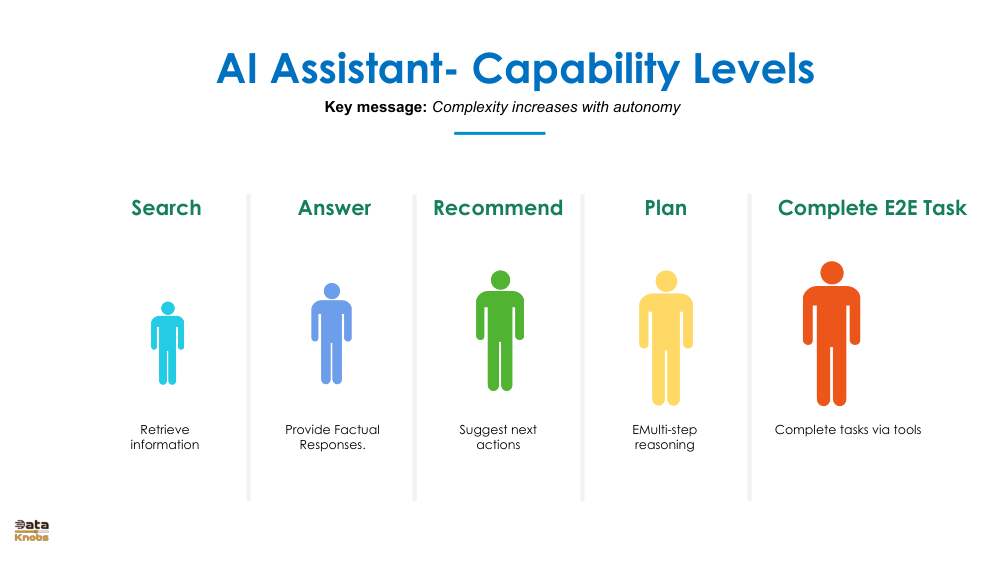
Large Language Models (LLMs) empower a wide range of advanced applications that extend well beyond basic keyword matching, with each iteration enhancing both complexity and functionality.
Five Core Types
🔍 Search
Utilize LLM and Vector Database technology to access information from knowledge bases.
💡 Answer
Utilize LLMs with current knowledge bases and grounding techniques such as RAG to give accurate responses.
🎯 Recommend
Recommend items based on user preferences and utilizing user behavior modeling systems.
📋 Plan
Empower users to set objectives and create detailed strategies that take into account various factors using cutting-edge AI logic.
⚡ Complete E2E Task
Carry out tasks for the user by merging various subtasks and interfacing with external systems.
Increasing Complexity →
02. LLM Applications & Capabilities Matrix
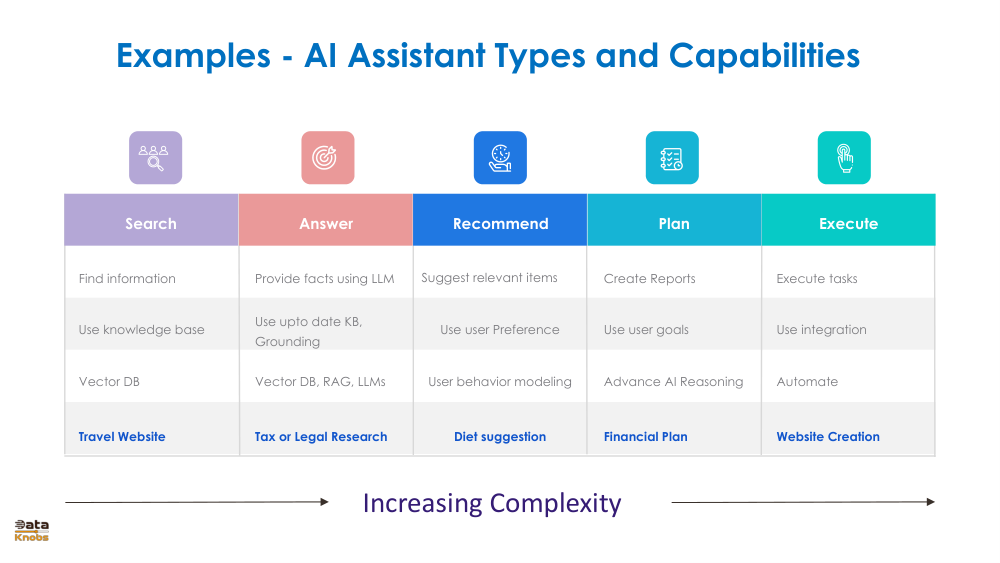
Various applications necessitate specific technical strategies and functionalities. Here is a detailed analysis:
| Application Type | Core Capability | Key Technology | Real-World Example |
|---|---|---|---|
| Search | Find information | Vector DB, Knowledge Base | Travel Website |
| Answer | Provide facts using LLM | Vector DB, RAG, LLMs | Tax or Legal Research |
| Recommend | Suggest relevant items | User Preference, Behavior Modeling | Diet Suggestion |
| Plan | Create Reports & Plans | Advanced AI Reasoning, User Goals | Financial Plan |
| Execute | Execute tasks with integration | Integration APIs, Automation | Website Creation |
Key Insight: Every new application type enhances existing capabilities. A system capable of task execution must also excel in planning, recommending, answering questions, and conducting effective searches.
03. LLM AI Assistant Features
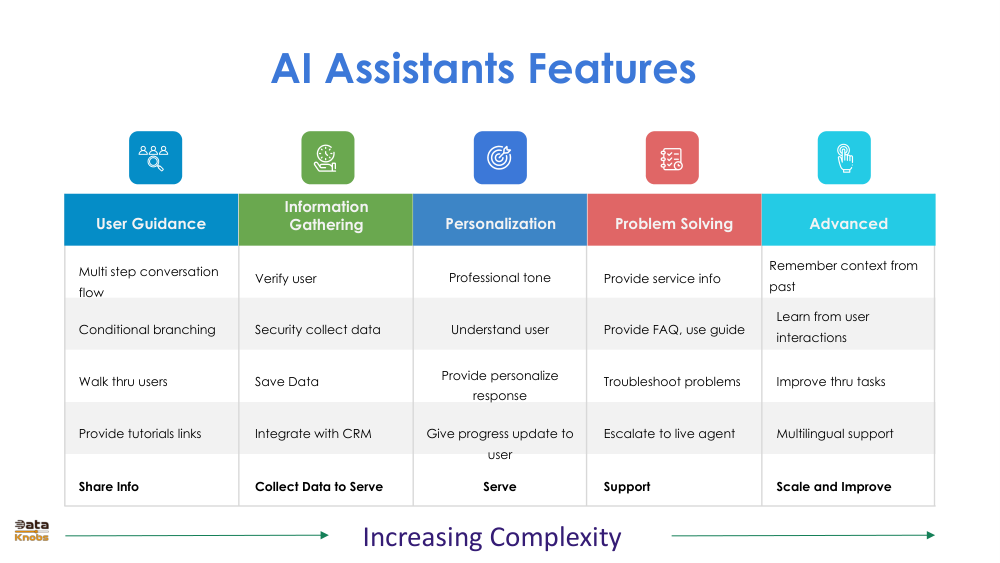
AI assistants in the modern era are crafted with growing intricacy to provide improved user interactions and operational effectiveness. They progress through five essential tiers of capabilities.
Five Levels of AI Assistant Sophistication
📖 User Guidance
Foundation Level
Multi-step conversations, conditional branching, guided walkthroughs, tutorial links, and information exchange. Consistently maintains a professional demeanor during interactions.
📊 Information Gathering
Data Collection Level
Ensuring user verification, implementing security measures, data collection and storage, and integrating with CRM systems. Laying the groundwork for personalized service delivery.
🎨 Personalization
Experience Level
Utilize user data to customize responses, track progress, and cater to individual preferences in every interaction.
🛠️ Problem Solving
Support Level
Offer service details, FAQs, troubleshooting tips, and access to live agents for further assistance when necessary. Ensures thorough customer support.
🚀 Advanced
Intelligence Level
Keep in mind the situation, absorb from engagements, enhance with assignments, and offer multilingual support. Constantly adapts to enhance user experience.
Increasing Complexity →
Assistant Features Summary
Core Capabilities Across All Levels
- Multi-step conversation flow - Guide users through complex processes
- Professional communication - Maintain brand voice and tone
- Context awareness - Remember past interactions
- Data security - Verify and protect user information
- Integration capabilities - Connect with business systems
- Continuous improvement - Learn from user interactions
- Multilingual support - Serve global audiences
04. Metrics & Performance Indicators
When assessing and integrating AI assistants, it is important to monitor various key metrics to guarantee effectiveness and ongoing enhancement.
Critical Performance Metrics
📈 User Engagement Metrics
- Conversation completion rate
- Average conversation length and depth
- User satisfaction scores
- Return user percentage
⚙️ Operational Metrics
- Response time and latency
- Escalation to human agent rate
- Cost per interaction
- System availability and uptime
🎯 Quality Metrics
- Accuracy of responses and recommendations
- Task completion success rate
- User feedback and ratings
- Error rate and fallback triggers
Success Factors
Successful AI assistants combine technical sophistication with user-centric designIt begins with simple guidance, progresses to data collection and personalization, advances to problem-solving, and transforms into intelligent systems that learn and improve continuously. Regularly monitoring these metrics ensures the assistant's ongoing effectiveness and value to users.
The AI Assistant Evolution
The introduction of AI assistants marks a significant change in customer interaction and information management for organizations. Utilizing Large Language Models allows businesses to offer:
✓ Scalability
Handle thousands of concurrent conversations without additional staffing costs.
✓ Availability
Provide 24/7 support across all time zones and geographies.
✓ Personalization
Deliver customized experiences based on individual user preferences and history.
✓ Consistency
Ensure uniform service quality and brand messaging across all interactions.
✓ Efficiency
Reduce operational costs while improving response times and user satisfaction.
✓ Intelligence
Continuously learn and improve through interaction data and feedback.
The Future: As LLM technology progresses, AI assistants will grow more advanced, adept at managing intricate tasks, offering deeper context comprehension, and seamlessly merging with enterprise systems for enhanced business impact.