The Autonomous Network

Agentic AI in
Telecom.

Transforming telecommunications from reactive operations to self-healing ecosystems. Discover how autonomous agents optimize bandwidth, resolve complex customer technical issues, and predict infrastructure failures before they happen.
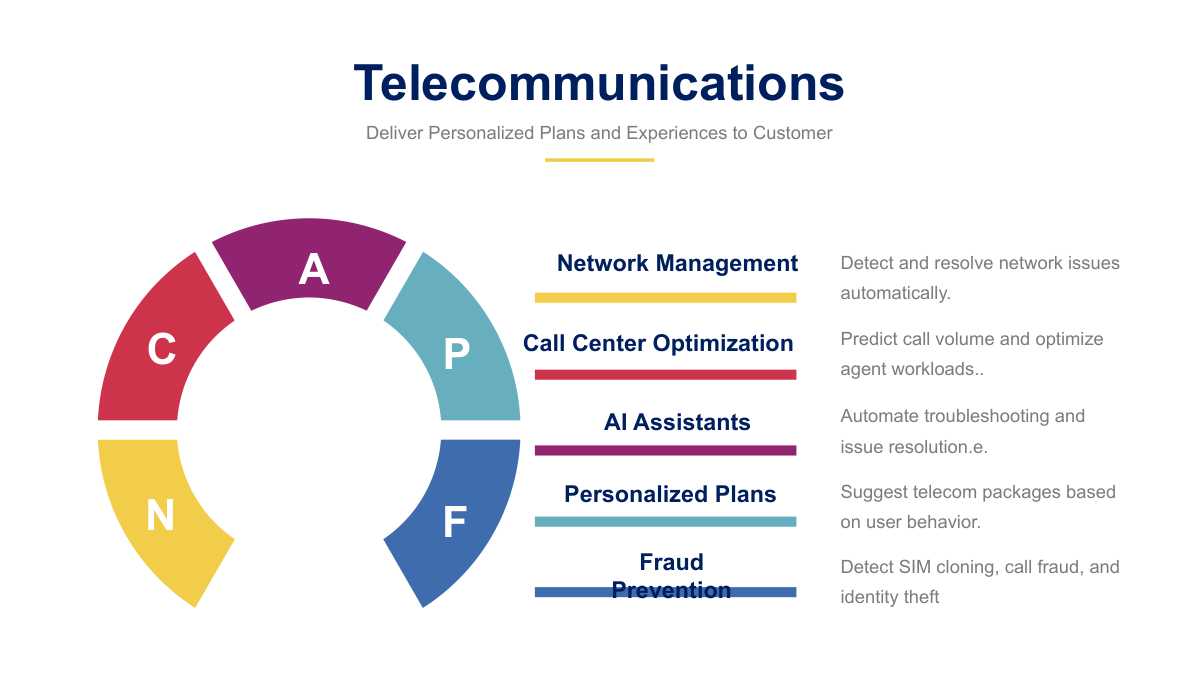
AI Agents in Telecom Domain Diagram

Orchestrating Connectivity

AI Agents manage the immense complexity of modern 5G and fiber networks by autonomously analyzing telemetry and executing real-time adjustments.

1. Autonomous Network Self-Healing

Agents continuously monitor network traffic across cell towers and data centers. If a node goes offline or bandwidth spikes unexpectedly (e.g., during a major live event), the agent autonomously reroutes traffic, provisions virtual network functions (VNF), and mitigates downtime instantly.

2. Intelligent Technical Support

Instead of basic chatbots, support agents can run diagnostics on a customer's specific hardware. They can autonomously query line status, remotely reset routers via APIs, parse complex billing disputes, and execute prorated refunds without escalating to a human technician.

3. Predictive Infrastructure Maintenance

Agents ingest telemetry from thousands of remote cell towers (temperature, power fluctuations, weather impact). They predict hardware degradation before failure, automatically ordering replacement parts and dispatching field engineers optimized by location.

4. Proactive Fraud Mitigation

Fraud agents autonomously analyze millions of call detail records (CDRs) in real-time. Upon detecting anomalies—such as SIM swapping attempts or international toll fraud routing—the agent can autonomously suspend compromised accounts and alert security teams.

Network Operations Center (NOC)

From Reactive NOCs to Autonomous Networks

Traditionally, managing a telecom network required massive Network Operations Centers (NOCs) filled with engineers staring at dashboards. When an alarm triggered, humans had to manually diagnose the fault, consult documentation, and type commands to fix the issue.

Agentic AI introduces the "Zero-Touch" NOC. By granting AI agents the ability to read alarms, access runbooks (RAG), and execute scripts via APIs, the network actively heals itself. Human operators transition from manual troubleshooters to high-level network strategists.

Reactive Operations

Legacy
  • • High Mean Time To Resolution (MTTR) for outages.
  • • "Alarm fatigue" causes engineers to miss critical events.
  • • Manual, time-consuming customer troubleshooting.
  • • Rigid bandwidth allocation unable to handle sudden spikes.

Agentic Orchestration

Modern
  • • Sub-second routing around network hardware failures.
  • • Automated diagnosis and execution of standard fixes.
  • • Instant, API-driven customer tech support.
  • • Predictive expansion of virtual networks based on demand.

Build the Self-Healing Network

Ready to reduce MTTR and optimize your infrastructure? Learn how to deploy autonomous agents that securely interface with your OSS/BSS systems and IoT sensors.