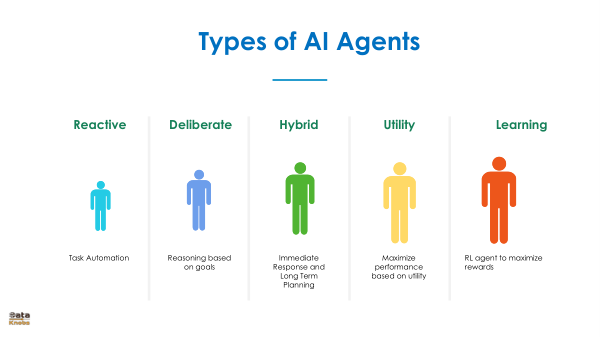
The 5 Core Types of Agents
From simple condition-action rules to complex, utility-maximizing machine learning models, explore the spectrum of agent cognition.
1. Simple Reflex Agents
The most basic AI. These agents act only on the basis of the current percept, completely ignoring the rest of the percept history. They operate on simple "Condition-Action" (If-Then) rules.
Example: A smart thermostat turning on AC when temp > 75°F.
2. Model-Based Reflex Agents
These agents maintain an internal state (a "model" of the world) to track aspects of the environment that are not currently visible. They combine current perceptions with past history to make decisions.
Example: A robot vacuum tracking which rooms it has already cleaned.
3. Goal-Based Agents
Moving beyond reflexes, these agents are given a specific objective. They use search algorithms and planning to project the future consequences of their actions to ensure they reach the defined goal.
Example: A navigation app finding the route to a specific destination.
4. Utility-Based Agents
These agents don't just want to reach a goal; they want to do it in the best way possible. They evaluate multiple paths and choose the action that maximizes a specific "utility" function (e.g., speed, safety, cost).
Example: A trading bot maximizing profit while minimizing risk.
5. Learning Agents
The pinnacle of agent architecture. Learning agents are capable of operating in unknown environments. They have a "critic" that evaluates performance and a "learning element" that updates their internal rules over time, allowing them to become more competent than their initial programming.
Example: Autonomous LLM agents (like AutoGPT) that write code, encounter errors, and rewrite their logic to fix them automatically.