Technical Deep Dive

Advanced
Agent Patterns.

To build highly reliable, enterprise-grade AI, you must orchestrate specific cognitive loops. Expand your understanding of Tool Use, Reflection, Planning, and Multi-Agent Collaboration.
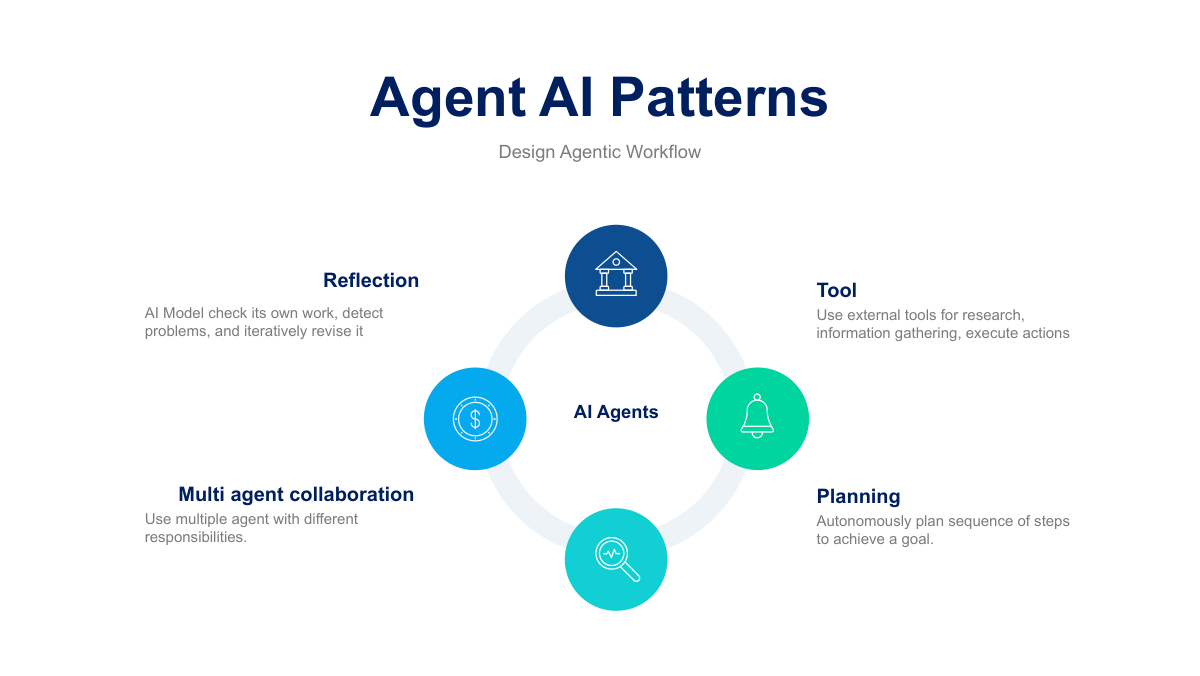
Advanced AI Agent Design Patterns Diagram

The Mechanics of Autonomy

Break down the four critical workflows that allow an LLM to reliably interface with the physical and digital world.

1. Tool Use & Function Calling

Agents are provided with a library of functions (e.g., search_web(), query_sql(), send_email()) described in JSON schema. The LLM acts as the router, evaluating the user's prompt and deciding which tool to invoke and exactly what parameters to pass into it.

Why it matters

It solves the "knowledge cutoff" and hallucination problem by allowing the model to fetch deterministic, real-time data from external APIs.

2. Reflection (Self-Correction)

Also known as the "Actor/Critic" pattern. The Actor agent generates a draft or executes a tool. The Critic agent (or the same LLM with a different prompt) immediately reviews the output against strict guidelines, identifies flaws, and sends it back for revision.

Why it matters

Dramatically increases the accuracy and quality of outputs by forcing the system to explicitly check its own work before presenting it to the user.

3. Task Planning & Decomposition

For complex requests, the agent uses paradigms like Chain of Thought (CoT) or Tree of Thoughts (ToT). It breaks a massive goal into a Directed Acyclic Graph (DAG) of sub-tasks. It solves Task A, uses the output for Task B, and maintains a "scratchpad" of state along the way.

Why it matters

Prevents the LLM from getting overwhelmed by complex instructions. Step-by-step processing ensures nothing is skipped or forgotten.

4. Multi-Agent Collaboration

Instead of one generic agent, you deploy a team of hyper-specialized "personas." A Supervisor/Orchestrator agent receives the prompt and delegates parts of the work to a "Researcher", a "Coder", and a "Writer". The agents pass messages back and forth to synthesize the final result.

Why it matters

Separation of concerns. System prompts remain small and highly focused, leading to vastly superior reasoning and fewer context window failures.

Under the Hood

Combining Patterns in Production

Enterprise AI rarely uses just one pattern. A robust architecture seamlessly blends Tool Use, Planning, and Reflection into a single autonomous loop.

// The Execution Trace

User:
"Research Q3 revenue for Acme Corp and write a summary."
Planning:
1. Fetch financial data for Acme Corp.
2. Filter for Q3.
3. Draft summary.
Tool Use:
> Executing Tool: query_sec_database(company="Acme Corp", quarter="Q3")
> Output: {"revenue": "$4.2B", "growth": "12%"}
Action:
Drafting initial summary based on $4.2B revenue...
Reflection:
CRITIQUE: The draft mentions revenue but forgot to highlight the 12% growth metric requested implicitly by "summary". Retrying...
Result:
"Acme Corp reported a strong Q3 with $4.2B in revenue, marking a 12% growth year-over-year."

Master Agentic Frameworks

Ready to implement these patterns? Explore open-source orchestration frameworks to begin building highly reliable, modular AI systems.