Move from linear to exponential growth. AI Agents deliver compounding business value by automating cognitive workflows, reducing operational costs, and scaling enterprise expertise infinitely.
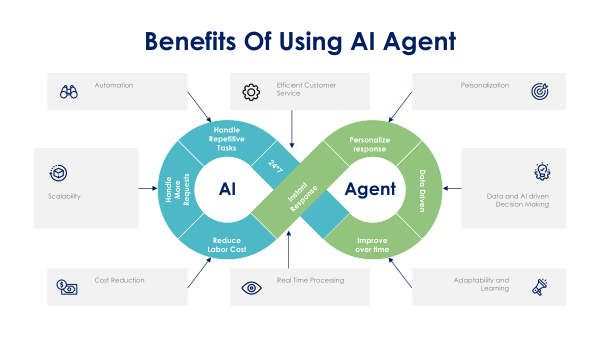
Integrating autonomous agents into your architecture unlocks efficiencies that traditional software and human labor simply cannot match.
Instantly spin up thousands of digital workers to handle sudden spikes in workload—whether it's customer support tickets during a holiday rush or mass data extraction—without the massive overhead of recruiting, onboarding, or training human staff.
Agents do not sleep, take breaks, or suffer from burnout. They operate continuously across global time zones, ensuring critical processes like threat detection, system monitoring, and client onboarding are executed the millisecond they are required.
By offloading tedious data gathering, document parsing, and repetitive cognitive tasks to agents, human employees are freed from the "busywork." This allows your talent to focus entirely on high-leverage strategy, empathy, relationship building, and innovation.
Unlike traditional scripts that break silently, advanced AI agents evaluate their own performance. They learn from their mistakes, update their memory vector stores, and refine their execution paths, resulting in progressively lower error rates over time.
The ultimate benefit of an AI Agent architecture is the decoupling of business growth from headcount growth.
In a traditional model, doubling your output requires doubling your workforce. With an agentic workflow, the marginal cost of executing a complex, multi-step process drops to near zero. You achieve high-speed, uniform quality, at a fraction of the cost.
Cost scales directly with output. Requires continuous training, management overhead, and physical infrastructure.
Cost is reduced to API compute tokens. Can handle 1x or 10,000x volume instantly while maintaining a perfect standard of execution and shared memory.
Ready to reap the benefits of AI Agents? Start by identifying bottlenecks in your current operations and designing your first autonomous workflow.