To build reliable and scalable autonomous systems, you must move beyond basic prompts. Discover the foundational architectural patterns that dictate how agents reason, plan, and execute tasks.
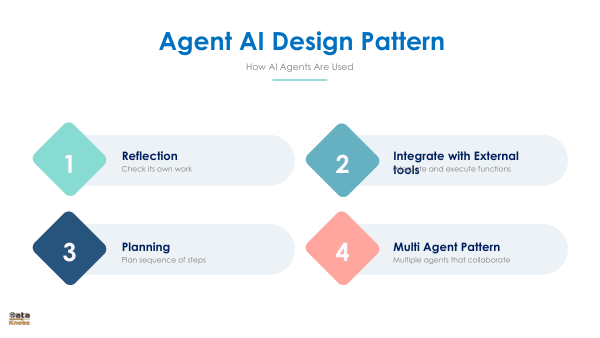
Depending on the complexity of your workflow, you will implement one or a combination of these core agentic design patterns.
The agent operates in a continuous loop of Thought, Action, and Observation. Before invoking a tool, it outputs a reasoning trace ("Thought: I need to find the user's email. Action: Search CRM..."). This interleaving of reasoning and acting significantly reduces hallucinations and improves tool usage accuracy.
Best for highly complex tasks. The workflow is split between two modules: a Planner that breaks the main objective into a sequential step-by-step list, and an Executor that methodically completes each step one at a time, checking them off to ensure nothing is missed.
Also known as Self-Correction. After an agent generates an output, a secondary prompt (or a separate "Critic" agent) reviews the work against strict criteria. If flaws are found, it sends feedback back to the generator to try again, creating an iterative improvement loop.
Rather than relying on one massive "God Agent," tasks are distributed to specialized sub-agents (e.g., a "Researcher" agent, a "Coder" agent, and a "QA" agent). They communicate with each other through a central Orchestrator, allowing for highly complex, parallel execution.
The naive approach to AI is cramming hundreds of instructions, edge-cases, and tool descriptions into a single, massive system prompt. This results in brittle, confused models that frequently "forget" instructions.
Agentic Engineering advocates for modularity. By using Multi-Agent frameworks (like LangGraph or AutoGen), you isolate responsibilities. A modular architecture is easier to debug, scale, and guarantees much higher accuracy for enterprise workloads.
One LLM call expected to plan, research, write, and critique simultaneously. Prone to context window overflow, hallucination, and failure on complex tasks.
Task is routed to specific, narrowly-scoped agents. The flow is managed by an orchestrator, allowing for deterministic loops, parallel processing, and distinct critique phases.
Ready to build production-grade AI? Learn how to implement ReAct and Plan-and-Execute loops using modern frameworks like LangChain and Semantic Kernel.