What elevates a software program from a simple script to an intelligent agent? It requires a unique blend of autonomy, goal-oriented behavior, continuous learning, and environmental awareness.
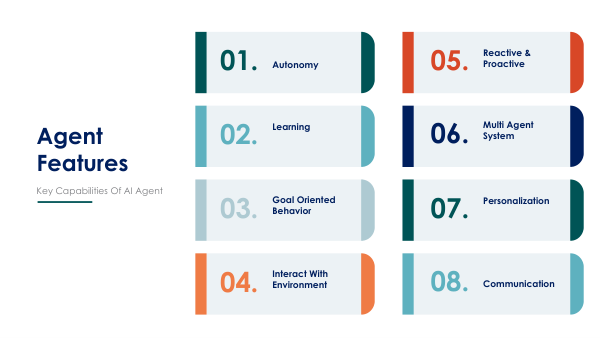
These core attributes define how AI agents perceive their world, make decisions, and execute tasks without human hand-holding.
The agent operates without continuous human intervention. It has control over its own actions and internal state, making independent choices about which tools to use and when to use them to solve a problem.
Agents are proactive, not just reactive. Given a high-level objective (e.g., "Increase website conversions"), the agent formulates a multi-step plan, prioritizes tasks, and continuously drives toward that specific outcome.
Through semantic memory and feedback loops, agents improve over time. They learn from past successes and failures, adapt to new environmental changes, and refine their strategies without needing to be reprogrammed.
Agents perceive their environment (via APIs, data streams, or text) and respond to changes in real-time. Furthermore, they feature social ability—communicating and negotiating with humans or other AI agents to resolve tasks collaboratively.
Traditional software relies on rigid, deterministic rules. If X happens, execute Y. But the real world is messy, unstructured, and unpredictable.
By combining Autonomy, Goals, and Learning, AI Agents transcend standard programming. They don't just execute code; they function as digital knowledge workers, capable of handling ambiguity, correcting their own errors, and finding creative solutions to complete the mission you assign them.
Learn how to combine Large Language Models with vector memory and tool orchestration to build agents that solve real business problems.