Vector Databases Overview
Learn how vector databases work, why they matter, and how they compare to traditional systems.
Learn how vector databases work, why they matter, and how they compare to traditional systems.
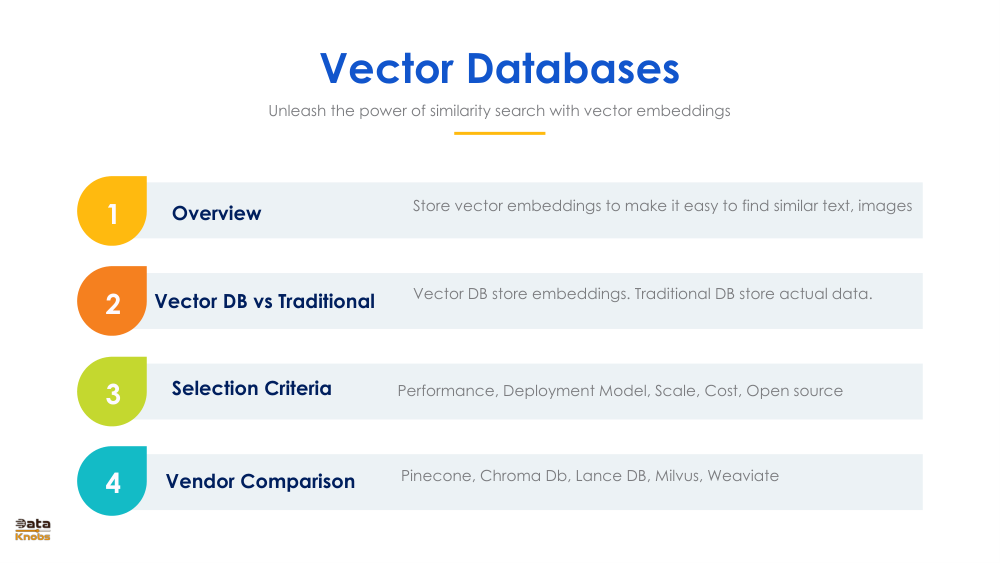
A vector database stores high‑dimensional vector embeddings and enables fast similarity search. These embeddings represent text, images, audio, and other content in numerical form so machines can compare meaning, context, and features.
Numerical representations created by machine learning models to encode semantic meaning.
Finds closest vectors using metrics like cosine similarity or Euclidean distance.
Designed to store and query billions of high‑dimensional vectors efficiently.
Does it support fast ANN search for your dimensionality and dataset size?
Evaluate horizontal scaling, sharding support, and memory efficiency.
Many workloads need vector + metadata search capabilities.
Low-latency queries matter for real-time AI apps.
Cloud, self-hosted, on-device—choose based on requirements.
Check SDK support and integration with AI frameworks.
Fully managed cloud vector DB with high performance and hybrid search.
Open-source ANN engine with strong scalability and index variety.
Includes modules for text, image, and hybrid search with GraphQL APIs.
Library for vector search, great for custom implementations.
Generally yes. Vector DBs provide fast semantic search used in retrieval pipelines.
They can store them, but are not optimized for similarity search.
Managed services can be, depending on scale. Open-source alternatives exist.
Deepen your understanding of AI data infrastructure and vector search.
Explore More Resources