How vectors power computer vision, NLP, recommendations, chatbots, audio, and search applications.
Vector databases store embeddings—numerical representations of text, images, audio, user behavior, and more. These embeddings enable machines to perform similarity search, classification, clustering, and retrieval at scale.
Modern AI applications rely heavily on vector databases for speed, accuracy, and relevance. Below are the core concepts and real-world use cases.
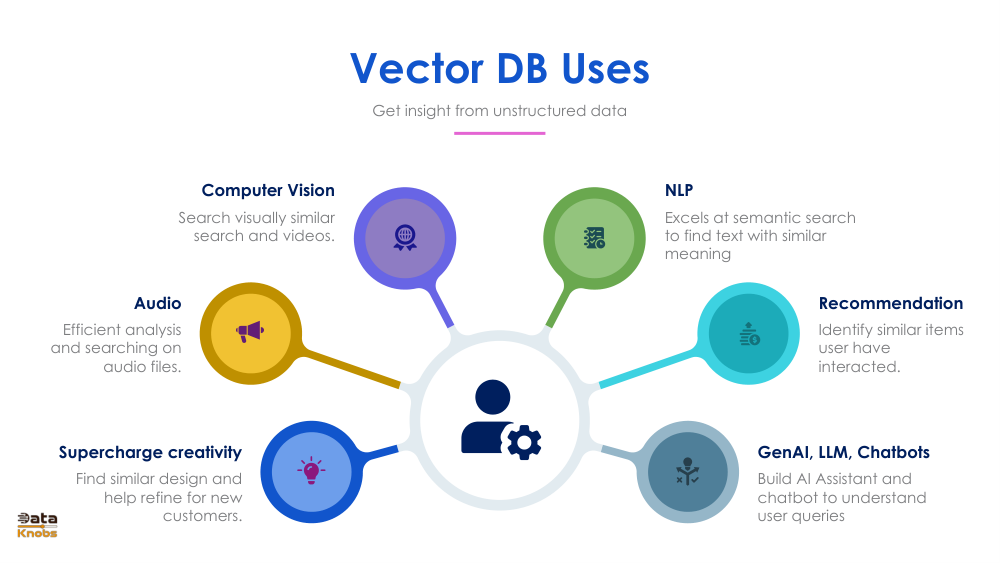
Numerical vectors representing meaning, similarity, or behavior.
Find nearest vectors to quickly retrieve the most relevant items.
Combine vector search with keywords, metadata, and filters.
Text, images, audio, logs, user behavior.
Models convert content into high‑dimensional vectors.
Vectors are indexed with ANN for fast retrieval.
System finds nearest vectors and returns results.
Image similarity, object recognition, visual search, deduplication.
Semantic search, topic clustering, summarization support, document retrieval.
Personalized ranking, related items, user preference modeling.
Context retrieval, memory, personalization, knowledge grounding.
Speaker identification, sound similarity, audio search, music matching.
Semantic search, hybrid filtering, intent understanding.
They enable semantic retrieval, powering modern AI systems efficiently.
Yes. Embeddings convert raw content into numerical vectors for comparison.
Most vector DBs support billions of vectors with millisecond latency.
Deepen your understanding and build powerful AI applications.
Explore More Resources