Understand how storage, search, and handling of high‑dimensional data differ between modern vector databases and classical relational or document databases.
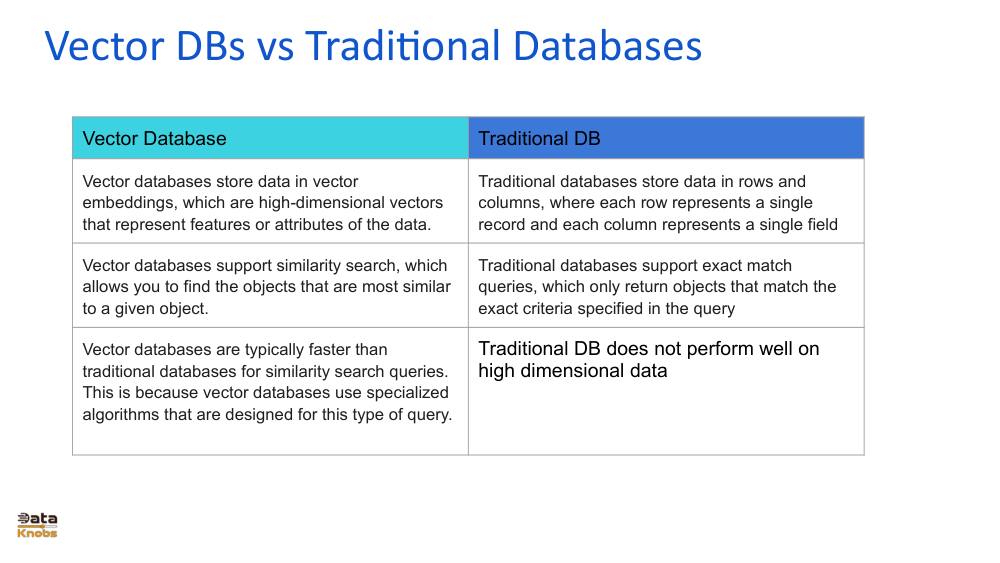
Traditional databases excel at structured data, exact matching, and transactional workloads. In contrast, vector databases store numerical embeddings representing meaning, enabling similarity search across high‑dimensional data.
This shift is critical for AI-powered search, recommendation systems, and applications where semantic relationships matter more than exact matches.
High‑dimensional vectors representing meaning extracted from text, images, audio, or structured data.
Finds vectors most similar to a query using metrics like cosine similarity, L2 distance, or dot product.
Vector indexes (HNSW, IVF, PQ) optimize large‑scale, approximate nearest‑neighbor search.
Data is converted into embeddings using models like Word2Vec, BERT, or OpenAI embeddings.
Embeddings are stored in high‑dimensional vector indexes optimized for rapid similarity search.
Queries are transformed into vectors and compared with stored vectors to return the most relevant results.
Search by meaning instead of keywords.
Find similar items, products, or users based on behavior or content.
Retrieve relevant knowledge chunks using vector search.
No. They complement each other. Vector DBs handle semantic and high‑dimensional tasks, while traditional DBs manage structured and transactional workloads.
Most store vectors and metadata. Raw data is often kept in a separate system or object storage.
It dramatically speeds up similarity search in large, high‑dimensional datasets with minimal accuracy loss.
Explore more resources and learn how vector search powers modern AI systems.
Learn More