Understanding the core focus, data model, and performance differences for modern search workloads
Search workloads have expanded beyond traditional keyword matching. As AI-powered applications grow, organizations must decide between classical text search engines like Elasticsearch and specialized vector databases optimized for high-dimensional embeddings.
This page breaks down the core differences between both technologies so you can choose the right one for your use case.
Elasticsearch uses inverted indexes to match exact or fuzzy terms in text documents.
Vector databases retrieve items based on numeric embedding similarity using distance metrics.
Combines keyword relevance with vector similarity to improve accuracy and recall in search workloads.
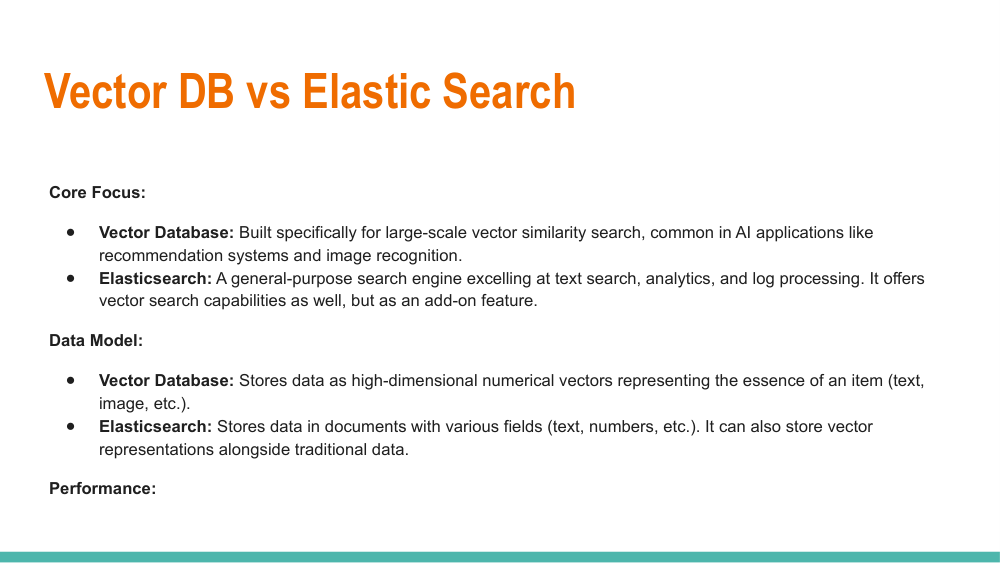
Elasticsearch: Text search, filtering, analytics.
Vector DBs: Semantic search and embedding similarity.
Elasticsearch: Documents + inverted index.
Vector DBs: High‑dimensional vectors + ANN/HNSW graphs.
Elasticsearch: Fast for text queries but slower for vector-heavy workloads.
Vector DBs: Optimized for large-scale vector retrieval and low-latency similarity search.
Elasticsearch: Proven distributed scaling for logs and documents.
Vector DBs: Built for scalable ANN clustering and embedding storage.
Yes, but vector search is not its core strength and performance is limited at scale.
No. They solve different problems and are often used together in hybrid systems.
Yes, embeddings power similarity search in vector models.
Explore deeper guides on vector search, embeddings, and modern AI data infrastructure.
Explore More