How vectors represent text, images, and multimodal data for similarity search.
Vector databases store high-dimensional numerical representations of data. These vectors capture the meaning, structure, and relationships embedded in text, images, audio, and multimodal inputs.
The number of dimensions in a vector depends on the model that generated it. More dimensions allow more expressive representations, but also come with computational trade-offs.
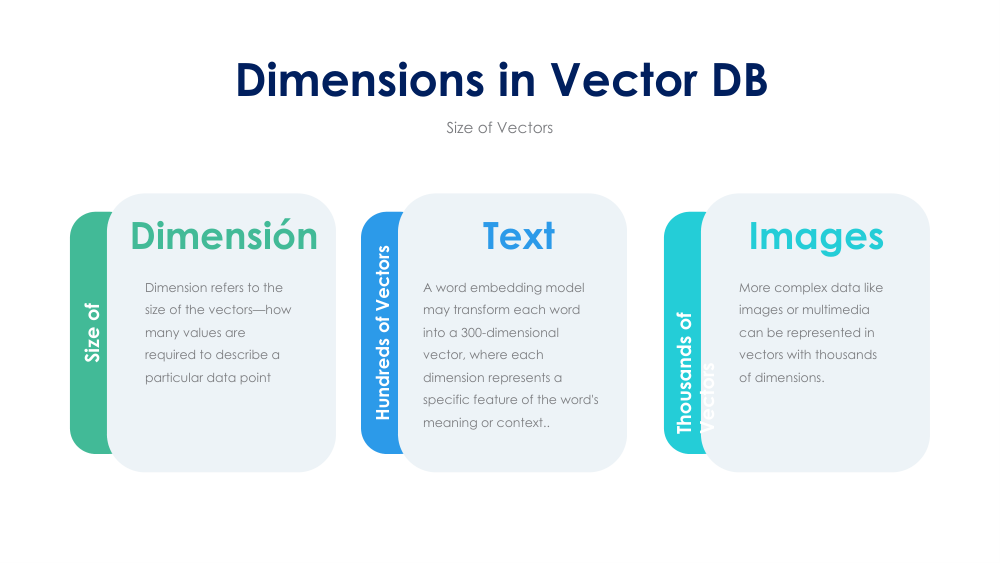
Each vector is an ordered list of numbers, often 128–4096 dimensions, representing features extracted by a machine learning model.
Models convert raw text, images, or mixed inputs into vectors. Similar items end up closer to each other in vector space.
Databases compare vectors using cosine similarity, dot product, or Euclidean distance to retrieve relevant results.
Input
User provides text, image, or multimodal data.
Embedding
Model transforms input into a numerical vector.
Indexing
Vector DB stores embeddings and builds ANN indexes.
Similarity Search
DB retrieves nearest vectors based on distance metrics.
Semantic search retrieves results based on meaning, not keywords. Useful for chatbots, documentation search, and knowledge retrieval.
Vectors can represent visual features, enabling reverse image search and visual similarity detection.
Combine text and images (e.g., "find shoes like this but red"). Models map different modalities into a shared vector space.
Vector similarity powers product recommendations, personalized feeds, and related content ranking.
Fast, efficient, less expressive.
Balanced power and performance.
Highly expressive, used for multimodal embeddings.
Higher dimensions allow the model to encode more nuanced meaning and features. This improves similarity matching accuracy.
Not always. More dimensions can improve expressiveness but also increase memory and search complexity.
Yes. Multimodal models map different types of inputs into a unified high-dimensional vector space.
Start building intelligent search and multimodal AI systems today.
Get Started