Generative AI – Slide 21 Explained
A clear breakdown of the concept from Slide 21, including examples, applications, and the underlying technical mechanics.
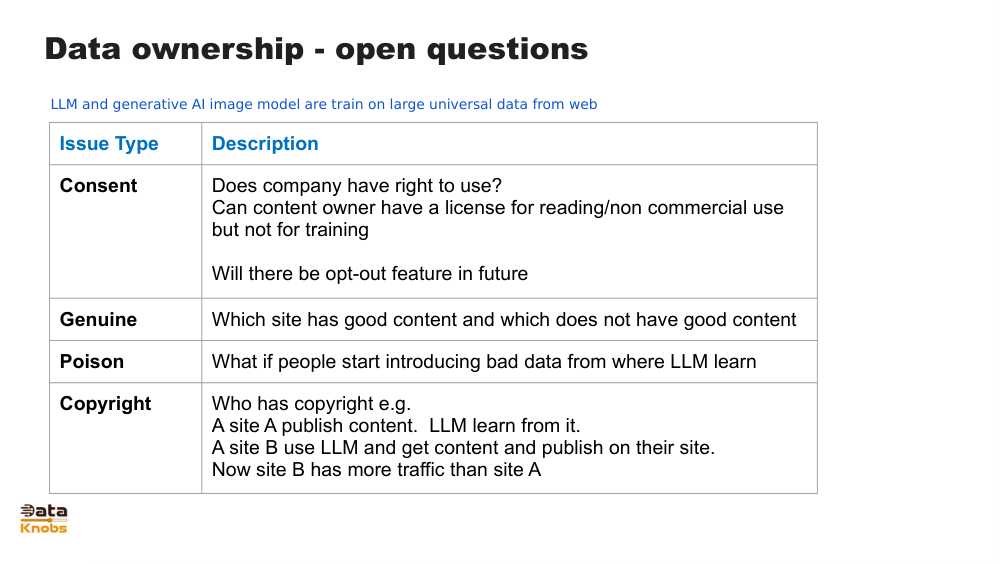
A clear breakdown of the concept from Slide 21, including examples, applications, and the underlying technical mechanics.
Slide 21 focuses on how generative models transform an input signal or prompt into new, coherent outputs such as text, images, audio, or structured data. It illustrates the flow of information through the model, emphasizing how learned representations guide generation.
Generative models learn abstract representations of data inside a compressed vector space. This latent encoding allows models to interpolate and produce new variations.
Outputs are generated by sampling from probability distributions learned during training, enabling diverse and creative results.
Prompts guide the generation process by steering the model toward relevant regions of latent space.
User provides text, an image, or structured instructions.
The model maps the input into a learned latent representation.
Sampling and decoding mechanisms produce new output.
Writing assistance, story creation, marketing copy.
Art generation, illustration, video frames, textures.
Generating 3D models or synthetic training data.
Chatbots, smart agents, workflow automation.
No. It learns patterns, not specific instances.
Yes. Sampling introduces diversity into generated outputs.
It enables smooth transformations and variations during generation.
Continue the tutorial to learn how modern models achieve high-quality generation.
Next Slides