Generative AI – Slide 87 Explained
Understand the core idea illustrated in Slide 87 with clear examples, applications, and a simple technical breakdown.
Understand the core idea illustrated in Slide 87 with clear examples, applications, and a simple technical breakdown.
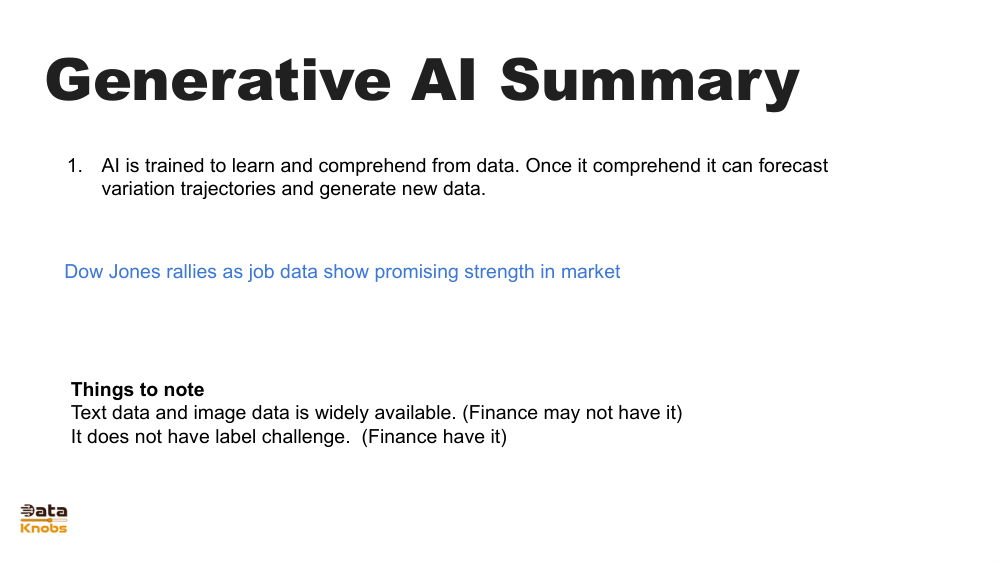
Slide 87 illustrates the idea of using generative models to transform input instructions into meaningful outputs by learning patterns from large datasets. It highlights how the model interprets user intent, maps it to internal representations, and produces coherent results.
User instructions are converted into vector representations that the model can process.
The model navigates a learned multidimensional space where meanings and relationships are stored.
Outputs are generated token-by-token based on probabilities and context awareness.
User provides text, example, or query.
Text is converted into dense vector embeddings.
The model identifies relationships and context in latent space.
The model predicts the best next tokens and forms a coherent result.
Writing, summarization, brainstorming, rewriting.
Code generation, debugging, architecture suggestions.
Cleaning, structuring, extraction from text or images.
Images, designs, storytelling, concept art.
It visually summarizes how generative models map user intent to generated output.
Latent space stores abstract learned relationships that allow the model to generalize.
No, generation involves probability and can vary between outputs.
Explore advanced concepts and build your own AI-powered tools.
View Next Lesson